Back to top Jump to featured resources
Featured Article, Resource filed under Independent Business

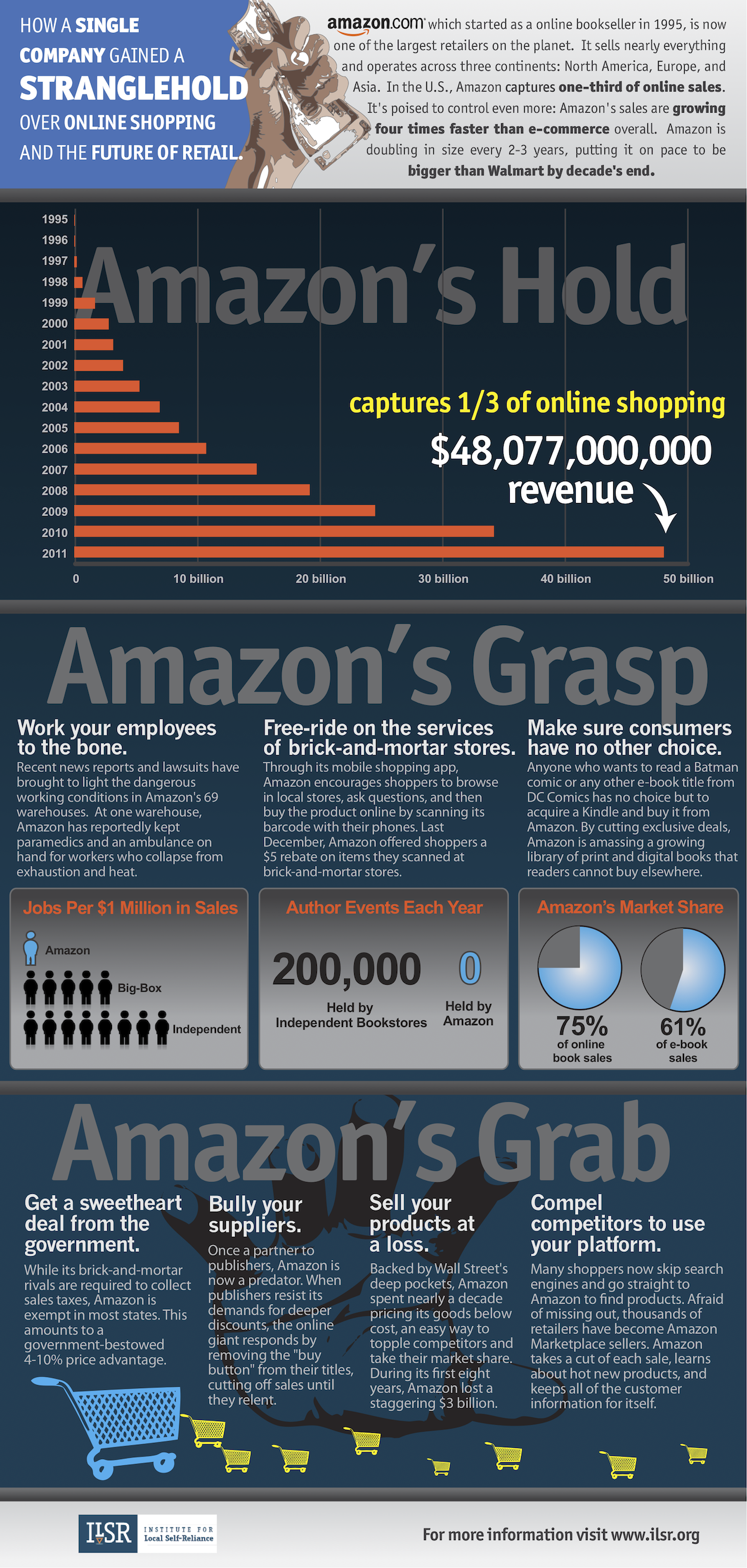
Amazon Infographic: How a Single Company Gained a Stranglehold over Online Shopping and the Future of Retail

| Written by Stacy Mitchell | 22 Comments | Updated on Jun 5, 2012 The content that follows was originally published on the Institute for Local Self-Reliance website at http://www.ilsr.org/amazon-infographic/

Tags: / / / / /

About Stacy Mitchell

Stacy Mitchell is a senior researcher with the Institute for Local Self-Reliance, where she directs initiatives on independent business and community banking. She is the author of Big-Box Swindle and also produces a popular monthly newsletter, the Hometown Advantage Bulletin.  Connect with her on twitter and catch her recent TEDx Talk: Why We Can’t Shop Our Way to a Better Economy. More

Contact Stacy   |   View all articles by Stacy Mitchell

22 Comments

Kasey Cox said...

I cannot thank you enough for compiling this information and stating these issues in such clear, concise, efficient terms. We try to explain this to people: some want to be educated, are interested in what we have to say on these issues, and are concerned with what they hear. Some people get angry, and literally say to us, “Well, I don’t care.” Some care but are ultimately lazy and do what is convenient — which is, too often, using Amazon, since Amazon has HUGE resources at its disposal now, and can streamline shipping, website searches, inventory availability, etc. We are here to offer a better alternative, but so many times, it seems spitting in the wind. Thank you for the boost, and the information to fight back.

Jun 5, 2012

How a Single Company Gained a Stranglehold over Online Shopping and the Future of Retail | The Big Picture said...

[...] Institute For Self Reliance PERMALINK Category: Consumer Spending, Digital Media, [...]

Jun 10, 2012

Random Thoughts from an Entrepreneur's Journey | Amazon Infographic – Random Thoughts from an Entrepreneur's Journey said...

[...] Source: http://www.ilsr.org/amazon-infographic/ /* */ 0 Comments/0 Likes/0 Tweets/posted in Business, Lifestyle ← Social Media Growth 0 replies Leave a ReplyWant to join the discussion? Feel free to contribute! [...]

Jun 12, 2012

Deric said...

Very well done! Thanks for creating this graphic.

Jun 13, 2012

Amazon Rules and How | The Penn Ave Post said...

[...] 2:01 on June 14, 2012 by Abby Zimet A great infographic explains how Amazon has come to have a stranglehold over e-commerce, and, given its fast growth, the likely future of retail. Lesson here: Buy local. [...]

Jun 14, 2012

GL said...

Well done!

Jun 15, 2012

RFC Music Business News Compilation / June 15th | Reeperbahn Festival CAMPUS Blog said...

[...] various instances of market concentration in the music business (something the RFC 2012 will do!) Amazon can be seen as a prime example of market dominance in the online retail field. The “Institue For Local Self-Reliance” has produced an interesting infographic on Jeff [...]

Jun 15, 2012

Tasiyagnunpa Livermont said...

Okay then, so you do realize those of us in rural areas with little shopping availability use Amazon quite a bit. Do you have alternatives for those of us in the middle of nowhere. Sure, we’d love to buy local, but many times that is not possible.

Jun 21, 2012

Rusty said...

Very well done. Members of Congress should be able to understand this.

Jun 21, 2012

Kaitlin Sopoci-Belknap said...

Stacy,

What does Amazon spend in political campaigns? It would be great to show how any influence there helped shape this story.

Thanks!
Kaitlin

Jun 21, 2012

Stacy Mitchell said...

@Tasiyagnunpa Livermont

Thanks for the comment. Yes, of course, we know avoiding Amazon is not always possible. That’s part of the concern we’re raising: a lack of meaningful choices for people. There are some independents online. For example, you can order both print and e-book titles from independent bookstores via http://www.indiebound.org/ and independent hardware stores have a e-commerce site through their cooperative, Ace: http://www.acehardware.com/. There are others as well.

But, while we think it’s important for people to choose local businesses when possible and feasible, we don’t think convincing people to change their shopping habits is really the answer. Or enough of an answer. Most of our work and advocacy focuses on changing public policy to level the playing field for independents. For example, we’ve worked to get states to be fair about ensuring that all retailers are subject to the same requirements regarding collecting sales taxes (Amazon does not in many states):
http://www.ilsr.org/rule/internet-sales-tax-fairness/

We have also advocated an end to the subsidies states have provided Amazon and other big retailers for the construction of warehouses and stores. And we advocate for stronger enforcement of antitrust laws to ensure a diverse marketplace where people have choices and where small businesses have an opportunity to compete.

Jun 22, 2012

Stacy Mitchell said...

@Kaitlin

Amazon spent about $2.2 million lobbying at the federal level in 2011. During the 2009-10 election cycle, they donated about $210,000 to federal candidates. I haven’t checked their state activity….

Stacy

Jun 22, 2012

Colin M. said...

Well done, thank you for posting this, what potent information!

Jun 23, 2012

Friday Links « 800 CEO Read said...

[...] books on the retail side of publishing? If so, you’ll want to check out an infographic about How a Single Company Gained a Stranglehold over Online Shopping and the Future of Retail at the Institute for Local Self-Reliance, or consider why the Consumer Federation of America [...]

Jun 26, 2012

“Hamazon”, Localism Link Love « indiegainesville said...

[...] Via. [...]

Jun 27, 2012

Marc Callado said...

Wonderful facts that reveal corrupt executive greed… Amazon is scary for our economic future!

Jul 16, 2012

The Economics Of The Google Gigabit – Forbes said...

[...] about those fascinating places, read Tubes by Andrew Blum — buy it through your local bookstore,not Amazon). Page 1 2 « Previous Page Next Page » 0 comments, 0 [...]

Aug 1, 2012

Ed Hermance said...

Is there a published source for saying Amazon spent $2.2 million on federal-level lobbying in 2011?
Thanks,

Sep 18, 2012

Ed Hermance said...

In the “Sell your products at a loss” section, it says Amazon “spent nearly a decade pricing its goods below cost.” If the company started in 1995, then that statement suggests that Amazon hasn’t been selling below cost for 8 years. We know that isn’t true. Amazon often offers new books at lower prices than I as a bookstore can buy them for.
Secondly, I don’t think it makes a strong enough statement about the effect on publishers of Amazon controlling the retail side of the marketplace. Amazon is going to end up telling publishers how much they will be paid for their books. Amazon will then control both sides of the marketplace, meaning there won’t be an American marketplace of ideas, just whatever Amazon decides to make public.

Sep 18, 2012

Stacy Mitchell said...

Opensecrets.org

Sep 18, 2012

Stacy Mitchell said...

Ed,

What’s nice about infographics is that they are concise and portable, so they spread across the web with great speed and reach. But the problem with tackling complex subjects in a concise format is that you inevitably must summarize and lose a level of detail.

Amazon posted losses for its first 8 years in business before it began turning a profit. The losses totaled $3 billion. Can you imagine if Wall Street handed independent bookstores $3 billion? Most of those that closed would still be around today. The point we wanted to make was that Amazon, backed by Wall Street, gained its initial place in the market by losing tons of money on everything it sold, a very predatory way to gain market share. Yes, I know, Amazon continues to use below-cost pricing to undermine competitors. (Though, in your case, it may be more a case of price discrimination — Amazon using its market power to solicit (potentially illegal) discounts from publishers that are unavailable to you.)

But tough to fit this all into an infographic and cover the range of issues we wanted to touch on.

We’ve written extensively about Amazon’s tactics and impact on the book industry elsewhere:
http://www.ilsr.org/tag/amazon/

Sep 18, 2012

David said...

Nice work!
Can you add a bibliography or a link to the sources?

Dec 10, 2012

  • http://www.wellsborobookstore.com Kasey Cox

    I cannot thank you enough for compiling this information and stating these issues in such clear, concise, efficient terms. We try to explain this to people: some want to be educated, are interested in what we have to say on these issues, and are concerned with what they hear. Some people get angry, and literally say to us, “Well, I don’t care.” Some care but are ultimately lazy and do what is convenient — which is, too often, using Amazon, since Amazon has HUGE resources at its disposal now, and can streamline shipping, website searches, inventory availability, etc. We are here to offer a better alternative, but so many times, it seems spitting in the wind. Thank you for the boost, and the information to fight back.

  • Pingback: How a Single Company Gained a Stranglehold over Online Shopping and the Future of Retail | The Big Picture

  • Pingback: Random Thoughts from an Entrepreneur's Journey | Amazon Infographic - Random Thoughts from an Entrepreneur's Journey

  • http://boldtypemag.com Deric

    Very well done! Thanks for creating this graphic.

  • Pingback: Amazon Rules and How | The Penn Ave Post

  • GL

    Well done!

  • Pingback: RFC Music Business News Compilation / June 15th | Reeperbahn Festival CAMPUS Blog

  • http://betweenleafandsky.wordpress.com Tasiyagnunpa Livermont

    Okay then, so you do realize those of us in rural areas with little shopping availability use Amazon quite a bit. Do you have alternatives for those of us in the middle of nowhere. Sure, we’d love to buy local, but many times that is not possible.

  • Rusty

    Very well done. Members of Congress should be able to understand this.

  • http://duhc.org Kaitlin Sopoci-Belknap

    Stacy,

    What does Amazon spend in political campaigns? It would be great to show how any influence there helped shape this story.

    Thanks!
    Kaitlin

  • http://www.ilsr.org/stacy-mitchell/ Stacy Mitchell

    @Tasiyagnunpa Livermont

    Thanks for the comment. Yes, of course, we know avoiding Amazon is not always possible. That’s part of the concern we’re raising: a lack of meaningful choices for people. There are some independents online. For example, you can order both print and e-book titles from independent bookstores via http://www.indiebound.org/ and independent hardware stores have a e-commerce site through their cooperative, Ace: http://www.acehardware.com/. There are others as well.

    But, while we think it’s important for people to choose local businesses when possible and feasible, we don’t think convincing people to change their shopping habits is really the answer. Or enough of an answer. Most of our work and advocacy focuses on changing public policy to level the playing field for independents. For example, we’ve worked to get states to be fair about ensuring that all retailers are subject to the same requirements regarding collecting sales taxes (Amazon does not in many states):
    http://www.ilsr.org/rule/internet-sales-tax-fairness/

    We have also advocated an end to the subsidies states have provided Amazon and other big retailers for the construction of warehouses and stores. And we advocate for stronger enforcement of antitrust laws to ensure a diverse marketplace where people have choices and where small businesses have an opportunity to compete.

  • http://www.ilsr.org/stacy-mitchell/ Stacy Mitchell

    @Kaitlin

    Amazon spent about $2.2 million lobbying at the federal level in 2011. During the 2009-10 election cycle, they donated about $210,000 to federal candidates. I haven’t checked their state activity….

    Stacy

  • http://www.hitherandyon.com/ Colin M.

    Well done, thank you for posting this, what potent information!

  • Pingback: Friday Links « 800 CEO Read

  • Pingback: “Hamazon”, Localism Link Love « indiegainesville

  • http://Shiftlocal.wordpress.com Marc Callado

    Wonderful facts that reveal corrupt executive greed… Amazon is scary for our economic future!

  • Pingback: The Economics Of The Google Gigabit - Forbes

  • http://queerbooks.com Ed Hermance

    Is there a published source for saying Amazon spent $2.2 million on federal-level lobbying in 2011?
    Thanks,

    • http://www.ilsr.org/stacy-mitchell/ Stacy Mitchell

      Opensecrets.org

  • http://queerbooks.com Ed Hermance

    In the “Sell your products at a loss” section, it says Amazon “spent nearly a decade pricing its goods below cost.” If the company started in 1995, then that statement suggests that Amazon hasn’t been selling below cost for 8 years. We know that isn’t true. Amazon often offers new books at lower prices than I as a bookstore can buy them for.
    Secondly, I don’t think it makes a strong enough statement about the effect on publishers of Amazon controlling the retail side of the marketplace. Amazon is going to end up telling publishers how much they will be paid for their books. Amazon will then control both sides of the marketplace, meaning there won’t be an American marketplace of ideas, just whatever Amazon decides to make public.

    • http://www.ilsr.org/stacy-mitchell/ Stacy Mitchell

      Ed,

      What’s nice about infographics is that they are concise and portable, so they spread across the web with great speed and reach. But the problem with tackling complex subjects in a concise format is that you inevitably must summarize and lose a level of detail.

      Amazon posted losses for its first 8 years in business before it began turning a profit. The losses totaled $3 billion. Can you imagine if Wall Street handed independent bookstores $3 billion? Most of those that closed would still be around today. The point we wanted to make was that Amazon, backed by Wall Street, gained its initial place in the market by losing tons of money on everything it sold, a very predatory way to gain market share. Yes, I know, Amazon continues to use below-cost pricing to undermine competitors. (Though, in your case, it may be more a case of price discrimination — Amazon using its market power to solicit (potentially illegal) discounts from publishers that are unavailable to you.)

      But tough to fit this all into an infographic and cover the range of issues we wanted to touch on.

      We’ve written extensively about Amazon’s tactics and impact on the book industry elsewhere:
      http://www.ilsr.org/tag/amazon/

  • David

    Nice work!
    Can you add a bibliography or a link to the sources?