
Back to top Jump to featured resources

Viewing all content from John Farrell Page 16 of 72

About John Farrell

John Farrell directs the Energy Self-Reliant States and Communities program at the Institute for Local Self-Reliance and he focuses on energy policy developments that best expand the benefits of local ownership and dispersed generation of renewable energy. More

Contact John   |   View all articles by John Farrell

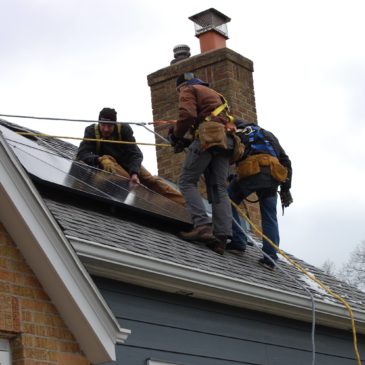
House with rooftop solar panels
Article filed under Energy | Written by John Farrell | 6 Comments | Updated on Jan 12, 2012

Solar Grid Parity 101

The content that follows was originally published on the Institute for Local Self-Reliance website at http://www.ilsr.org/solar-grid-parity-101/

Solar grid parity is considered the tipping point for solar power, when installing solar power will cost less than buying electricity from the grid.  It’s also a tipping point in the electricity system, when millions of Americans can choose energy production and self-reliance over dependence on their electric utility. But this simple concept conceals a… Continue reading

chart-2
Article filed under Energy | Written by John Farrell | No Comments | Updated on Jan 11, 2012

Democratic energy policy means strong public support for renewables

The content that follows was originally published on the Institute for Local Self-Reliance website at http://www.ilsr.org/democratic-energy-policy-means-strong-public-support-renewables/

Conducted by market research institute Forsa on behalf of municipal utilities in Germany, the survey found that 61 percent of Germans are willing to pay more for their power if the extra cost helps ramp up the share of renewables. Public acceptance even extends to acceptance of wind turbines “in my backyard”; 54 percent of those surveyed said they would find it “good” or “very good” if a wind turbine were set up nearby.

That’s the German feed-in tariff at work…

Continue reading

Advanced Electric Meter
Article filed under Energy | Written by John Farrell | 2 Comments | Updated on Jan 9, 2012

How Electricity Pricing Can Boost Distributed Solar – Part 1

The content that follows was originally published on the Institute for Local Self-Reliance website at http://www.ilsr.org/how-electricity-pricing-can-boost-distributed-solar-part-1/

Update 1/12/12: I created a new post to reflect the current time-of-use pricing plan for Los Angeles Update 1/10/12: Fixed a missing pie chart and corrected a miscalculation caught by a reader What if electricity cost more when the sun was shining? Many utilities are using new electronic “smart meters” to adjust the price of… Continue reading

Solar Thermal Parabolic Trough
Article filed under Energy | Written by John Farrell | 2 Comments | Updated on Jan 3, 2012

Some Skepticism on Solar Thermal Power’s Storage Potential

The content that follows was originally published on the Institute for Local Self-Reliance website at http://www.ilsr.org/some-skepticism-solar-thermal-powers-storage-potential/

Yesterday New York Times reporter Matt Wald had a piece on the role of energy storage in supporting the expansion of renewable energy.  However, his specific focus on solar thermal power generation overlooks the potentially high costs of relying on solar thermal power as well as the potential for distributed “storehousing” of renewable energy. Solar… Continue reading

On air with microphone
Article, ILSR Press Room, Resource filed under Energy | Written by John Farrell | No Comments | Updated on Dec 19, 2011

John Farrell Talks Democratizing the Electricity System Through Decentralizing Power on WKBM

The content that follows was originally published on the Institute for Local Self-Reliance website at http://www.ilsr.org/john-farrell-talks-democratizing-electricity-system-through-decentralizing-power-wkbm/

In this Nov. 20 interview with Baruch on his WKBM Paradigms program, we talked about: The coming decentralization of the electricity system The folly of a building inherently decentralized technology (wind and solar) in a centralized fashion The benefits for local ownership of a decentralized system How limited economies of scale for solar and wind… Continue reading

John Farrell
Article, ILSR Press Room, Resource filed under Energy | Written by John Farrell | No Comments | Updated on Dec 15, 2011

John Farrell Talks Renewable Energy Incentives and Boulder’s Municipal Energy Effort with Tom McKinnon on KGNU

The content that follows was originally published on the Institute for Local Self-Reliance website at http://www.ilsr.org/john-farrell-talks-renewable-energy-incentives-and-boulders-municipal-energy-effort-tom-mcki/

In this short interview on KGNU’s science show – How on Earth– with Tom McKinnon, we talk about: the problems presented for local ownership of energy resources when federal incentives use the tax code, the trouble for clean energy when it’s reliant on Wall Street, how Boulder, CO, may accomplish something remarkable with its vote… Continue reading

Article filed under Energy | Written by John Farrell | 51 Comments | Updated on Dec 14, 2011

Mapping Solar Grid Parity

The content that follows was originally published on the Institute for Local Self-Reliance website at http://www.ilsr.org/mapping-solar-grid-parity/

Where does solar grid parity strike first?  How fast does it spread?  Click “animate” on the map below to see which major metropolitan areas can beat grid prices with local solar first, and how quickly unsubsidized solar could take over America’s major metropolitan areas.

Continue reading

Article filed under Energy | Written by John Farrell | No Comments | Updated on Dec 13, 2011

Solar Gets Cheaper, but Not Equally

The content that follows was originally published on the Institute for Local Self-Reliance website at http://www.ilsr.org/solar-gets-cheaper-not-equally/

In January, I plotted the size of state solar markets against their average installed cost and found surprisingly little correlation.  When Lawrence Berkeley Labs put out their 2011 version of Tracking the Sun (IV), it was possible to update the chart, which I did in two stages. The first chart simply overlays the 2010 average… Continue reading

Article filed under Energy | Written by John Farrell | No Comments | Updated on Dec 12, 2011

Distributed generation needs less backup than centralized power generation

The content that follows was originally published on the Institute for Local Self-Reliance website at http://www.ilsr.org/distributed-generation-needs-less-backup-centralized-power-generation/


One doesn’t need 540 MW of reserve to back up 540 MW of small-scale distributed generation, but one does need it to back up a single critical 540 MW unit.

Continue reading

Article filed under Energy | Written by John Farrell | 2 Comments | Updated on Dec 7, 2011

U.S. Climate Negotiator Calls for Feed-in Tariffs

The content that follows was originally published on the Institute for Local Self-Reliance website at http://www.ilsr.org/us-climate-negotiator-calls-feed-tariffs/

From a friend at the United Nations climate meeting in Durban, South Africa:

Todd Stern, the head of the climate change negotiating team for the US Government called for Feed-in Tariff policies as key to solve the problem. Stern gave the briefing on December 7th to nearly 300 environmental group leaders in Durban, South Africa at the UN Climate Change negotiations. One of his major points was that the US and countries worldwide need to utilize the Feed-in Tariff approach in order to transform the energy production sector of society. While there was at best, luke warm, reception to his overall presentation of the US negotiating position, the crowd was impressed with his recognition of the transformative power of the German style renewable energy (Feed-in) approach. By providing investor security these policies have proven to be the fastest way to get gigawatts of good energy on line the quickest. As they say, when the house is on fire speed matters. [emphasis added]

Since feed-in tariffs are responsible for nearly two-thirds of the world’s wind power and 90 percent of the world’s solar, it’s a policy that would make sense for the American energy market.

Continue reading