Back to top Jump to featured resources

Viewing the Distributed Generation tag archive Page 19 of 31

Term for Energy

Article filed under Energy | Written by John Farrell | No Comments | Updated on Oct 29, 2010

Homes with Solar Sell Faster, and For More

The content that follows was originally published on the Institute for Local Self-Reliance website at http://www.ilsr.org/homes-solar-sell-faster-and-more/

In by far the most exhaustive and detailed study to date, the National Renewable Energy Laboratory (NREL) found that solar homes sold 20% faster, for 17% more than the equivalent non-solar homes, across several subdivisions built by different California builders.

The study looked at a number of housing developments where the homes were otherwise identical except for the solar energy systems. 

Also interesting was that buyers were more interested in solar when it was-preinstalled:

If solar was already on the house, and factored into the price already, buyers were more likely to pick a house with solar. But if it was just one more decision to be made at the point of purchase, the decision got shelved.

Continue reading

Article filed under Energy | Written by John Farrell | No Comments | Updated on Oct 21, 2010

German utility creating a “swarm” of combined-heat-and-power plants

The content that follows was originally published on the Institute for Local Self-Reliance website at http://www.ilsr.org/german-utility-creating-swarm-combined-heat-and-power-plants/

This initiative was announced in September 2009 with the goal of using 100,000 household-sized combined-heat-and-power gas units to provide grid electricity and home heat. The units would provide enough power to supplant two nuclear power plants. The video about the project was released (in English) just recently:


Continue reading

Article filed under Energy | Written by John Farrell | No Comments | Updated on Oct 21, 2010

Distributed solar less variable than centralized solar

The content that follows was originally published on the Institute for Local Self-Reliance website at http://www.ilsr.org/distributed-solar-less-variable-centralized-solar/

Traditionally, the reliability of small PV systems’ power output has been a concern for utilities, project developers and grid operators, since all it takes is a few clouds to disrupt the power flow of a small array. But the Berkeley Lab study suggests that when PV plant arrays are spread out over a geographic area, the variability in power output is largely eliminated.

This means that for utilities, the distributed generation of small PV arrays could mean increased efficiency, reduced costs and a quicker path to a cleaner energy portfolio.

Continue reading

filed under Energy | Written by John Farrell | No Comments | Updated on Oct 20, 2010

Better smart grids serve consumers, not just utilities

The content that follows was originally published on the Institute for Local Self-Reliance website at http://www.ilsr.org/better-smart-grids-serve-consumers-not-just-utilities/

But what’s most interesting is the state’s desire to make sure that investment in smart grid technology will pay off not just for utilities, but for consumers as well. For instance, Hawaiian environmental groups are apparently pushing for rooftop solar panels, a more green approach, than simply better managing supply and demand via a network-enabled smart grid.

Continue reading

filed under Energy | Written by John Farrell | No Comments | Updated on Oct 19, 2010

Why we need a local energy movement

The content that follows was originally published on the Institute for Local Self-Reliance website at http://www.ilsr.org/why-we-need-local-energy-movement-0/

When author Michael Pollan spoke at Cal Poly San Luis Obispo in mid-October, it’s a safe bet his hosts didn’t offer fresh cherries to the “local foods” advocate. As a locavore — someone who tries to eat only food grown within a 100-mile radius of them — Pollan would have likely reacted to cherries like a vampire reacts to garlic. At this time of year, any fresh cherries in northern California would most likely have come from orchards in Chile, roughly 6,000 miles to the southeast.

Yet, when Pollan was handed the microphone he probably did not turn to David Wehner, Dean of the college hosting the event, and ask, “By the way, Dean – Where did the electricity powering this thing come from?”

Maybe he should have.

At least some of that electricity had just completed a 1,000 mile journey. The energy was converted from wind to electricity at the Klondike generating facility just south of the Washington-Oregon border. The electricity traveled over power lines down the entire state of Oregon, then traversing three-quarters of the length of California to arrive at the microphone in Pollan’s hand at Cal Poly. So, does it matter that this electricity began life 1,000 miles from the microphone it powered?

That question is at the heart of the report, “Energy Self-Reliant States,” published in October by the New Rules Project. The report shows why “local energy” matters and then looks at the renewable energy potential of each state.

Continue reading

Article filed under Energy | Written by John Farrell | No Comments | Updated on Oct 19, 2010

Distributed, Small-Scale Solar Competes with Large-Scale PV

The content that follows was originally published on the Institute for Local Self-Reliance website at http://www.ilsr.org/distributed-small-scale-solar-competes-large-scale-pv/

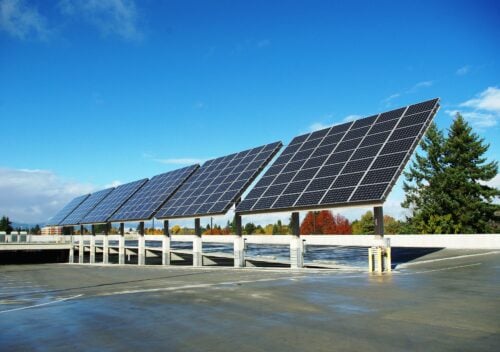
Distributed solar photovoltaic (PV) proponents have recognized that solar is not without economies of scale – larger installations generally have lower installed costs per Watt of peak capacity.  But new data suggests that these economies are significantly smaller than previously believed.  This is good news for solar and great news for the renewable energy movement…. Continue reading

filed under Energy | Written by John Farrell | No Comments | Updated on Oct 14, 2010

Use wind energy close to home

The content that follows was originally published on the Institute for Local Self-Reliance website at http://www.ilsr.org/use-wind-energy-close-home/

We could explore the possibility of eliminating the need for long-transmission lines and utilize wind energy closer to the source (Minnesota and Iowa are two states that have done this successfully).

Source: Steve Jarding, Campaign Manager, Heidepriem for Governor (South Dakota)

Continue reading

Article filed under Energy | Written by John Farrell | 1 Comment | Updated on Oct 4, 2010

Policy to Maximize On-site Use from Distributed Generation

The content that follows was originally published on the Institute for Local Self-Reliance website at http://www.ilsr.org/policy-maximize-site-use-distributed-generation/

Distributed generation (DG) puts energy production close to where it is consumed, often on people’s homes or in their backyards.  But just having a rooftop solar module doesn’t mean that every kilowatt-hour produced from sunlight is used in the home.  In fact, it’s often less than one-third, with the remaining energy production flowing out into… Continue reading

Article filed under Energy | Written by John Farrell | No Comments | Updated on Sep 20, 2010

Open Neighborhoods community solar makes solar PV in LA a homerun

The content that follows was originally published on the Institute for Local Self-Reliance website at http://www.ilsr.org/open-neighborhoods-community-solar-makes-solar-pv-la-homerun/

Residential solar PV in Los Angeles is getting a huge boost from a new community solar buying group. With typical residential installation costs for crystalline solar PV, residents would see a 20-year payback on a solar PV installation or a minimal 2% IRR on a 25-year investment (without factoring an inverter replacement).  But what about… Continue reading

wwsisstudypr.jpg
Article, ILSR Press Room filed under Energy | Written by John Farrell | No Comments | Updated on Jun 3, 2010

Energy Self-Reliant States Get A Boost From New Federal Study

The content that follows was originally published on the Institute for Local Self-Reliance website at http://www.ilsr.org/energy-selfreliant-states-get-boost-new-federal-study/

A new study by the National Renewable Energy Laboratory (NREL) reinforces the findings of a 2009 report by the Institute for Local Self-Reliance (ILSR).  The ILSR report, Energy Self-Reliant States, concluded that all 50 states could generate at least 25 percent of their electricity needs from in-state renewable energy while 31 could generate over 100 percent.  Continue reading