

Back to top Jump to featured resources

Viewing the pv tag archive

MN solar standard 8 vivid charts
Article, Resource filed under Energy | Written by John Farrell | No Comments | Updated on May 13, 2013

8 Vivid Charts – 8 Reasons for a Solar Energy Standard in Minnesota

The content that follows was originally published on the Institute for Local Self-Reliance website at http://www.ilsr.org/8-vivid-charts-8-reasons-solar-energy-standard-minnesota/

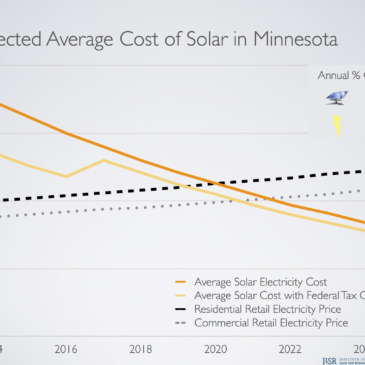
A conference committee is resolving differences between House and (much weaker) Senate versions of a solar energy standard in Minnesota today.  Here’s 8 graphic reasons why the state should go for solar as aggressively as it can. 8 Vivid Charts – 8 Reasons for a Solar Energy Standard in Minnesota from John Farrell Continue reading

Lowering Soft Costs Means Big Solar Savings
Article, Resource filed under Energy | Written by John Farrell | No Comments | Updated on Apr 29, 2013

Soft Costs Make a Bigger Difference as Solar Gets Cheap

The content that follows was originally published on the Institute for Local Self-Reliance website at http://www.ilsr.org/soft-costs-bigger-difference-solar-cheap/

Last week’s graphic on the impact of local permitting on the cost of solar power was a big hit, so here’s a follow up on “soft costs,” the expenses in a solar installation (including permitting) that are not the solar module.  The chart compares the soft costs in the U.S. to Germany (thanks to LBNL’s… Continue reading

chart solar cost and permitting 2013
Article filed under Energy | Written by John Farrell | No Comments | Updated on Apr 26, 2013

Local Permitting Makes a Bigger Difference as Solar Gets Cheap

The content that follows was originally published on the Institute for Local Self-Reliance website at http://www.ilsr.org/local-permitting-bigger-difference-solar-cheap/

Going solar keeps getting cheaper, but most of the cost savings have come from less expensive solar panels.  “Soft costs,” like permitting and inspections, are a rising share of the cost of a solar installation.  Several years ago, these permits could increase the cost of a residential solar project (then around $8.00 per Watt) by… Continue reading

Article filed under Energy | Written by John Farrell | No Comments | Updated on Jul 21, 2011

Overcoming the Roadblocks: Democratizing the Electricity System

The content that follows was originally published on the Institute for Local Self-Reliance website at http://www.ilsr.org/overcoming-roadblocks-democratizing-electricity-system/

A serialized version of our new report, Democratizing the Electricity System, Part 5 of 5. Click here for: Part 1 (The Electric System: Inflection Point) Part 2 (The Economics of Distributed Generation) Part 3 (The Political and Technical Advantages of Distributed Generation) Part 4 (Regulatory Roadblocks to Democratizing the Electricity System) Download the report. The… Continue reading

Article filed under Energy | Written by John Farrell | No Comments | Updated on Nov 22, 2010

Increasing On-Site Consumption of Distributed Solar

The content that follows was originally published on the Institute for Local Self-Reliance website at http://www.ilsr.org/increasing-site-consumption-distributed-solar/

It’s rarely mentioned that a home with a solar array still gets most of its electricity from the grid.  In fact, without storage, a typical home solar array might only serve one-third of a home’s electricity use, even if the system is big enough to meet the home’s peak needs. The problem is a mis-match… Continue reading

Article filed under Energy | Written by John Farrell | No Comments | Updated on Oct 21, 2009

Utilities take a shine to (distributed) solar

The content that follows was originally published on the Institute for Local Self-Reliance website at http://www.ilsr.org/utilities-take-shine-distributed-solar/

Rooftop solar is no longer the playground for granolas and Germans. But even when utilities join the solar PV game, they find that the distributed nature overcomes many of the technical and political barriers. A 2008 change in federal tax policy opened the door to utilities to invest in solar PV and utilities like PG&E are planning sizable installations (250 MW). PG&E will do a ground-mounted field of modules in the desert, but other utilities are finding distributed PV makes more sense:

Southern California Edison already plans to scatter 1 MW and 2 MW rooftop PV installations across its service territory, part of its goal to deploy 250 MW of PV over the next five years. Minimizing transient spikes is one reason. A second is that transmission remains the No. 1 barrier to renewable energy growth in California, says Mike Marelli, the utility’s director of renewable and alternative power contracts. “We can implement smaller systems with little or no transmission” additions, he says.

It’s hard to argue that transmission is a barrier when you’ve got 250 MW coming online without it! The good news is that the distributed solar also helps overcome some of the variability issues with solar power:

“During cloudy periods, the output from PV can get noisy with spikes,” which can have an effect on the grid, says Kelly Beninga, global director of renewable energy for WorleyParsons. PV installations around 20 MW in size can be managed without too much trouble. Larger than that and portions of the grid can be affected by passing clouds… To better understand the issue, NV Energy is studying power output variations that may result from deploying PV in and around Las Vegas. The study won’t be complete for another year, but Tom Fair says early data suggest that geographic dispersion helps dampen variability. A second finding is that solar facilities need to be placed on strong parts of the grid. “That leads us away from having huge amounts of PV at any one site,” Fair says. Ten to 20 MW at any one site might be the limit.

The utility interest in solar PV may help remove some of the stigma, and show that even small-scale modules can have a big-scale impact.

Photo credit: Schroeder, Dennis – NREL Staff Photographer

Continue reading